
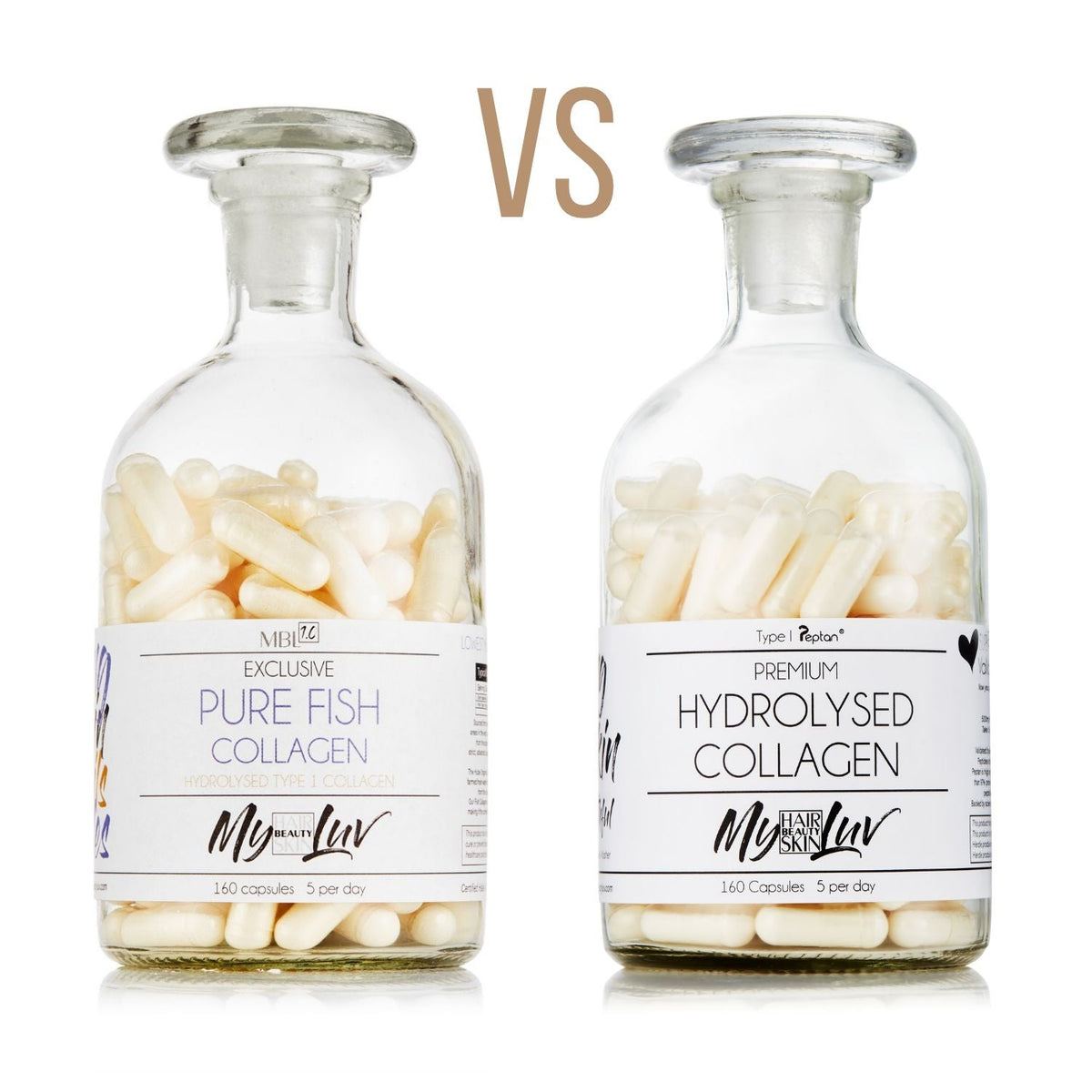
Marine vs bovine collagen is the question we hear most from people choosing their first collagen supplement. The short answer: both are rich in Type I collagen, and current research does not show a clear winner for skin. The better choice depends on what you eat, what you tolerate and what you want from a supplement. This guide compares the two, explains what the evidence does and does not show, and helps you decide.
Marine vs bovine type 1 collagen at a glance
| Marine (fish) collagen | Bovine collagen | |
| Source | Fish skin or scales. Our Pure Aquatic Fish Collagen uses freshwater-farmed tilapia | Cattle hide. |
| Main collagen type | Type I | Type I (some products add Type III) |
| Particle size | Often described as smaller. Our tilapia collagen states 860 Da (dalton) | Varies by brand - usually between 2000 Da and 3000 Da |
| Suits | Pescatarians, people avoiding red meat | People without dietary requirements |
| Works on | Skin, hair and nails (not joints) | Skin, hair and nails (not joints) |
What is hydrolysed collagen?
Collagen is a structural protein found in skin, bone, tendons and connective tissue. Supplement collagen is hydrolysed, which means the protein has been broken into small peptides so it dissolves easily and is simpler to digest. Your body digests these peptides along with the rest of your protein intake and uses the building blocks where it needs them. It is not delivered straight to your skin.
What does the research say about collagen for skin?
A 2023 systematic review and meta-analysis pooled 26 randomised controlled trials with 1,721 participants. It found that hydrolysed collagen improved skin hydration and elasticity compared with placebo. For elasticity, there was no significant difference between collagen sources. For hydration, results varied by source and by how long people took it, so this is not proof that one source is better.
The authors also noted risks of bias in the included trials and called for larger studies. In other words, collagen supplements show promise for skin, and the evidence is still developing.
Marine collagen: what to know
• Source: made from fish skin or scales and mostly Type I collagen. 'Marine' is supposed to come from ocean-farmed or wild caught fish from the seas.
• Particle size: marine peptides are often marketed as smaller and better absorbed. We have not found head-to-head human trials proving this though.
• Our Pure Aquatic Fish Collagen: hydrolysed Type I collagen from tilapia farmed in fresh water, using organic aquaculture. The normal dose is 5 capsules a day, and a 160-capsule bottle lasts 32 days.
• Who should avoid it: anyone with a fish allergy, and vegetarians and vegans.
Bovine collagen: what to know
• Source: made from cattle hide, mainly Type I collagen, with Type III in some products.
• Peptan®: a branded collagen peptide developed in France. Our Peptan® Premium Bovine Collagen is Type I, with a normal dose of 5 capsules a day and 32 days per bottle.
• Who should avoid it: anyone avoifing a red meat diet and vegetarians / vegans.
How to choose between marine and bovine collagen
• You avoid beef or eat a pescatarian diet: choose marine.
• You have a fish allergy or dislike fish products: choose bovine.
• Your goal is skin hydration and firmness: either can suit you. Pick the one you will take every day.
• Your goal is hair and nails: the evidence is thinner than for skin, so keep expectations modest.
• You care about sourcing: ask any brand where its collagen comes from and how it is made.
What to look for in any collagen supplement
1. Hydrolysed collagen peptides, not whole collagen protein.
2. A stated collagen type (Type I for skin-focused products).
3. A named source, such as bovine hide or farmed tilapia.
4. A clear dose per serving so you can compare products fairly.
5. No unnecessary bulking agents and no promises that sound too good to be true.
How long before you notice a difference?
The trials in the meta-analysis ran from 2 to 12 weeks. Plan for at least 8 to 12 weeks of consistent daily use before judging results. Sun protection, not smoking, enough sleep and enough protein matter at least as much as any capsule.
Our take
There is no wrong answer between the two. If you want a fish-based option, our Pure Aquatic Fish Collagen is Type I collagen from freshwater tilapia. If you prefer bovine, our Peptan® Premium Bovine Collagen is Type I as well. Either way, consistency beats everything else.
These statements have not been evaluated by SAHPRA. This product is not intended to diagnose, treat, cure or prevent any disease. If you have a serious health condition, or are unsure, consult a doctor or healthcare practitioner before use.